Rice is a remarkable crop. It is unique in how it evolved, how it grows, and how it became the foundation of nearly half the meals eaten around the world.
Recently, I traded a Florida summer for two equally hot and humid trips across Georgia, Alabama, and Louisiana. I visited farmers who are growing and processing heirloom rice varieties for consumers while reclaiming an important part of their agricultural and cultural heritage.
These farmers want to become certified organic. I made these visits to learn about their operations and help them develop Organic System Plans so they can apply for certification.
All of these farmers are part of a cooperative enterprise called Jubilee Justice.
A Brief and Incomplete History of Rice
Rice is one of the few foods that was domesticated twice.
Like wheat, oats, and barley, rice comes from the grass family. Unlike those grains, however, rice was developed into a food crop in two different places and at two different times in human history.
The scientific genus for rice is Oryza. Within that genus are two major domesticated species.
The first is Oryza sativa, the Asian rice varieties. These were first cultivated in China near the end of the last Ice Age, roughly 10,000 years ago.
The second is Oryza glaberrima, which was independently domesticated in West Africa from local wild grasses in what is now Cameroon. It became an important crop around 3,000 years ago as Bantu-speaking peoples expanded across the region and spread their agricultural knowledge.
About 500 years ago, seeds of O. glaberrima were among the crops carried by enslaved Africans to the Americas. Some accounts describe rice seeds hidden in women's hair during the transatlantic slave trade. African rice became an important food crop throughout the southeastern colonies and the early United States.
At the same time, another rice variety from Madagascar was becoming an important commercial crop. Today we know it as Carolina Gold Rice, a variety of the Asian species O. sativa. Throughout the colonial period and the era of slavery, it was cultivated as a major cash crop.
Yet enslaved African families also grew their own rice from heirloom seed carefully preserved from their homelands.
These heirloom varieties of O. glaberrima are the focus of Jubilee Justice today. For simplicity, I will refer to them as African rice throughout this article.
African rice generally grows taller than Asian rice and tolerates a wider range of growing conditions. Its height helps shade out weeds, and it is often more resistant to pests. However, it typically produces lower yields than O. sativa.
Because global rice markets are dominated by Asian varieties, most consumers are unfamiliar with African rice. Today, only about 20 percent of the rice grown in West Africa is African rice, and only a tiny fraction of the rice grown in the United States belongs to this species.
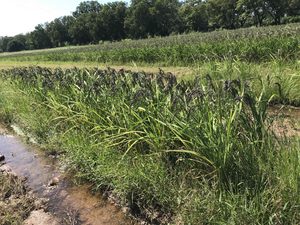
But the rice itself is only one thread in a much larger story.
The deeper story is about a network of Black farmers working together to shape their families' futures through farming and greater control over how their food is processed and distributed. Rice is the foundation, but community is at the heart of the work.
Where the Modern Story Begins: Jubilee Justice
During the COVID-19 pandemic, Konda Mason returned to her roots in the Deep South. She left behind a comfortable life in California and founded Jubilee Justice, inspired by what she and her friends describe in different ways: a midlife awakening, a personal epiphany, or one of those moments when life's purpose suddenly becomes clear.
Konda realized she was in a position to help Black farmers reclaim land and strengthen their place in Southern agriculture. She also believed that organic farming had to be part of the solution.
Working with a close circle of friends, she launched Jubilee Justice as a nonprofit organization. Together, they established a 15-acre farm in Alexandria, Louisiana, which is certified organic for crop production. From there, they recruited and organized a cooperative of farmers across Georgia, Alabama, Mississippi, and Louisiana. These farmers were willing to learn organic grain production and work together to control their own processing, marketing, and distribution.
Over time, that circle of friends grew into a much larger community.
Five or six years later, Jubilee Justice has expanded well beyond its beginnings. Supporters helped secure private financing by investing in the vision and mission of the organization. That funding allowed the group to build its own grain mill, which runs entirely on solar power.
The group acknowledges the irony that some components of the solar system come from companies whose leadership may not share their values. Konda takes a practical view. The equipment works, and it allows the cooperative to process its crops on its own terms.
At the mill, rice moves through cleaning, threshing, separation, and color-sorting equipment before being packaged for sale.
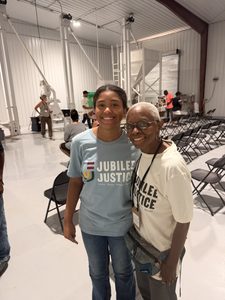
In September, I joined more than 200 farmers, supporters, and friends at the Jubilee Justice home farm in Alexandria for a two-day gathering. The event included tours of the farm and mill, opportunities to connect with members of the extended Jubilee Justice community, and fundraising efforts to support the organization's continued growth.
Like many young agricultural enterprises, Jubilee Justice is still working toward financial stability. Building infrastructure and creating new markets takes time, and the organization is currently covering substantial operating losses as it grows.
The mill is designed to process more than rice. It can also handle corn and wheat, three crops that together provide a large share of the world's calories. Yet many people in the cooperative are interested in producing a much broader range of grains.
During my visit, farmers spoke enthusiastically about sorghum, millet, and other crops that could become part of the system in the future. Rice serves as the cooperative's flagship product, but the long-term vision is much larger. The goal is to create a processing and distribution network that can support many crops grown by many farmers.
Speaking to supporters gathered inside a greenhouse-style meeting hall, Konda emphasized that community is the organization's greatest strength.
According to Konda, Jubilee Justice works because it is built on relationships. The people involved see themselves not only as business partners but also as friends and family. That sense of connection has helped sustain the organization through its early challenges and continues to attract new supporters.
Konda often describes herself as a social entrepreneur but she is really a leader in environmental and social justice. She is quick to point out that she is not one of the farmers, though she has learned a great deal about agriculture through the work.
I would add that she understands something equally important: how food systems operate. She recognizes how distributors, brokers, and middlemen have often captured much of the value in agriculture while farmers, especially Black farmers, have received far less than their fair share.
During my visit, I learned a great deal about rice production. I saw how the crop grows, how it is managed in the field, and how it is processed after harvest.
But what stayed with me most was not the rice.
What impressed me most was the way Jubilee Justice is cultivating community. The crops are important, but the deeper work is about building relationships, creating opportunities, and helping families shape their futures through agriculture.
Where the Story Grows: Jubilee Justice Farmers
To understand Jubilee Justice, you have to understand the people behind it. The cooperative is built on relationships, shared knowledge, and a commitment to helping one another succeed.
One of the people who best represents that spirit is Collie Graddick, secretary of the Jubilee Justice farmer cooperative.
Collie is hard to miss. His half-gray beard is often paired with an oversized smile. His lean farmer's frame is matched by long twists of hair that fall from beneath a ball cap most days, or a cowboy hat when the occasion calls for it. Most importantly, he is always moving. There always seems to be another field to visit, another farmer to help, or another project in motion.
Collie studied agricultural science, earning a bachelor's degree from Fort Valley State University in Georgia and a master's degree from Tuskegee University in Alabama. Today, he works as an agricultural extension agent at Fort Valley State while helping coordinate much of the cooperative's rice effort.
He lives in Columbus, Georgia, near the Alabama border and close to land his family has owned since shortly after emancipation. During my travels, I had the opportunity to meet his mother, who still lives on Graddick Road in Hamilton, Georgia, where Collie grew up.
I met Collie before I ever met Konda Mason or any of the other Jubilee Justice farmers.
We first shook hands at Clemson University's Organic Essentials event in South Carolina in July. The event brought together farmers interested in transitioning to organic production. During the conference, Collie and I developed a plan to tour farms connected to the Jubilee Justice network.
Soon afterward, he followed up with an ambitious itinerary.
When I mapped out the route, it became clear that I was in for a serious road trip. The plan included stops in Albany, Georgia; Tuskegee University; Union Springs, Alabama; Columbus and Hamilton, Georgia; Fort Valley State University; and finally the small Georgia communities of Uvalda and Portal near Vidalia.
As often happens with farm visits, the schedule evolved along the way. We returned to Fort Valley twice, explored multiple sites in both Columbus and Union Springs, and spent long hours discussing the opportunities and challenges facing each operation.
Before going any further, it is worth clarifying something about the rice itself.
The farmers in Jubilee Justice grow both African rice (Oryza glaberrima) and Asian rice (Oryza sativa). The cooperative's mission centers on preserving and expanding African rice production, but farmers also grow familiar commercial varieties because consumers already know them and demand them.
Many of those varieties are attractive, nutritious, and delicious in their own right.
Over the course of my August visits in Georgia and Alabama, and later during my September visit to Louisiana, I was able to see every rice variety currently being grown within the cooperative, along with many of the other crops that support these farming operations.
The first stop on that journey was the farm closest to Florida.
Resora - New Communities
I arrived at Resora in Albany, Georgia, shortly before noon on August 21.
My first impression was that the property felt both majestic and welcoming. A coded gate guarded the entrance. After calling Collie for instructions, I entered and drove up a long lane past a large manor house and through towering pecan trees.
Eventually, I reached an agricultural building near the farm office and parked.
At the time, I thought that I knew very little about the history of the place.
I soon learned from Collie that Resora is the current incarnation of an agricultural land-access project that began in the 1960s as the New Communities Land Trust, founded by Shirley Sherrod, her family, and their partners.
I had first learned about New Communities back in 2018 while working as a Farmland Access Director at a community land trust in New England.
Community land trusts acquire and hold land on behalf of the people who use it. Agricultural land trusts apply that concept to farming, creating affordable access to farmland for growers who might otherwise be unable to buy land.
The organization where I worked supported community gardens in cities and commercial farm plots in rural areas. Within that world, New Communities was widely respected.
People often referred to it as the grandmother of agricultural land trusts because it was the first community land trust in the United States.
The story was also considered tragic.
Many of us believed that New Communities had effectively disappeared after a severe drought devastated its crops. Unable to repay federal loans, the organization lost control of roughly 5,000 acres of land.
What I learned from Collie that morning was far more hopeful.
New Communities survived.
Through persistence, legal action, and years of hard work, the organization rebuilt itself. Following a settlement with USDA, it was eventually able to acquire the land that now makes up Resora.
Learning that the organization had endured and recovered genuinely delighted me.
Naturally, my next question was whether they had T-shirts.
They did.
Originally, I had planned to meet Kenyatta Sherrod there in Albany for the farm tour. What I failed to realize beforehand was that the farmer on my list was directly connected to New Communities Land Trust.
The Sherrod family continues to lead New Communities, and Kenyatta manages agricultural operations on the approximately 1,600-acre property.
When I finally connected all the dots, I was struck by how fortunate I am to do this work with Florida Organic Growers and the Southeast Transition to Organic Partnership Program. Few jobs allow you to meet such fascinating people and visit places with such important histories.
Kenyatta was delayed in Atlanta that day, so the farm tour fell largely to Collie.
We climbed into a small utility vehicle and headed into the fields. Beyond the pecan grove, the landscape opened dramatically. To one side stood fenced garden areas. An old farmhouse sat in the distance. Nearby, a carefully managed pine forest stretched across the property, with trees spaced to make pine-straw harvesting easier.
Collie explained that an outside contractor collects pine straw from the property for use as mulch.
We eventually reached a field where roughly three acres were enclosed by six-foot fencing designed to exclude deer and other wildlife.
The fencing was effective against larger animals, though smaller pests remained a challenge. Additional protection around the base might help keep out some of those intruders.
Inside the fenced area was the Jubilee Justice production system. To one side stretched more than 20 acres of mowed grass. Within the enclosure, crops occupied only a portion of the available land.
About three-quarters of an acre was planted in jasmine rice.
The crop looked healthy. Plants stood roughly two feet tall and were actively flowering. I saw no obvious signs of disease or significant insect pressure.
Nearby, approximately half an acre was planted in hibiscus.
The hibiscus appeared vigorous and well established, though it had not yet begun flowering.
The rice had been transplanted using a water-wheel transplanter pulled by a tractor. Workers place seedlings into the machine while the tractor moves through the field, creating evenly spaced plantings.
The beds were raised and covered with landscape fabric perforated to allow seedlings to emerge at specific intervals.
Some hibiscus had also been transplanted, though most of those plants had been direct-seeded.
Much of the remaining field was resting in rotation.
The land was not neglected. It was simply between production cycles.
Collie uses a three-stage rotation:
- Rice
- Vegetables and hibiscus
- Cover crops and rest
Most of the Jubilee Justice production blocks follow this same pattern.
Many farmers in the cooperative manage three-acre systems divided into one-acre sections that rotate through these phases over time.
At the end of the tour, we moved into the air-conditioned office and called Kenyatta to discuss organic certification plans.
What began as a conversation about certifying the three-acre rice system quickly became something larger.
Kenyatta explained that he wanted to certify more than a single field.
He wanted Resora itself to return to organic certification.
"We used to have 50 acres certified organic, and we have the capacity to manage that paperwork through the land trust," he explained.
His vision included rebuilding that certification program and eventually expanding it beyond the current Jubilee Justice acreage.
The organization plans to work with Florida Organic Growers to develop a new Organic System Plan and submit a fresh certification application.
For now, the economic foundation of the property remains its pecan operation.
Those pecans are grown conventionally, and Kenyatta was not yet ready to transition them to organic production. After years of work, the grove has finally become profitable, and protecting that success is understandably a priority.
Still, both Collie and Kenyatta see opportunities to add value.
At one point, Collie joked that there is undoubtedly a market for "Miss Shirley's Pecan Pie."
Whether or not Shirley Sherrod actually bakes pies, he argued, people would buy a product connected to her story and legacy.
As a farmer who has spent plenty of time exploring value-added enterprises, I found it difficult to disagree.
By the end of the day, our conversation had covered rice, land access, pecans, certification, history, marketing, and pie.
The next morning, however, the journey would continue.
Collie and I planned to meet at Tuskegee University, where he maintained a rice demonstration plot used for teaching and outreach. It was several hours away, and the afternoon was slipping by.
I had a hotel reservation waiting in Auburn, Alabama.
After saying goodbye for the evening, I headed west and prepared for another day on the road.
Riding with Collie Graddick
Collie met me at my hotel in Auburn the next morning, and we drove together to Tuskegee in my rental car.
As we traveled, the conversation moved easily between farming, education, and the growing network of Jubilee Justice farmers. Before long, we passed through the main university campus and entered Tuskegee's agricultural area.
Our destination was a demonstration plot that Collie uses for workshops and outreach activities.
The plot sat behind the Sustainability Center. A short walk from the building brought us to a neatly organized area, roughly 20 by 30 feet in size, covered with black landscape fabric and planted in rice.
The rice was healthy, though less vigorous than what I had seen at Resora.
The difference was understandable. Unlike the fields in Albany, this site did not have an automated irrigation system. Water had to be supplied by hand and on a more limited schedule.
We spent a few minutes inspecting the plants and watering them. None had yet produced mature seed, but the crop was developing normally.
The demonstration plot is small, but it plays an important role.
For Collie, the goal is not simply to grow rice. The plot serves as a teaching tool. It allows students, farmers, and members of the community to see the crop up close and learn how it can be produced within an organic system.
After finishing in the field, we stopped by the office to visit with Demetrius Hooks, Tuskegee's Farm Internship Liaison and Collie's primary contact on campus.
Much of their discussion focused on irrigation.
Collie was concerned that the rice was not receiving enough water, and he was working with Hooks to find a practical solution. Any system would need to survive routine mowing and maintenance around the facility, which had already complicated a few attempts.
From there, we toured other agricultural areas on campus.
We looked across open fields and newly constructed high tunnels before driving to Tuskegee's certified organic farm.
The visit sparked a conversation about the future of the rice project.
Collie and I discussed whether it would make sense to certify the demonstration area for organic production. The more practical option, however, might be to relocate the project entirely into the existing organic farm.
From what I observed, the farm appeared to have plenty of available space. That said, I do not know the university's long-term research plans, and there may be reasons certain fields remain unused.
Still, the opportunity seemed clear.
Rather than creating a separate certification pathway, it might be simpler to integrate the rice into infrastructure that already exists.
The organic farm is certified for approximately 16 acres. Rice is not currently listed as a certified crop, but adding it would likely be straightforward if the university chose to move in that direction.
More important than the certification paperwork, however, was the larger significance of the site.
Tuskegee has long been a center for agricultural education and innovation. Standing there, it was easy to imagine how a small demonstration plot could grow into something larger. Students could gain hands-on experience. Farmers could learn new production methods. Researchers could evaluate varieties and management practices.
For a project focused on rebuilding agricultural knowledge and opportunity within Black farming communities, Tuskegee felt like a natural partner.
Eventually, though, the day's schedule pushed us onward.
We left campus, grabbed lunch, and headed south toward Union Springs, Alabama.
There, Collie planned to show me several additional sites connected to the Jubilee Justice network. The roads ahead would reveal both the promise and the challenges of expanding organic rice production across the region.
Like many agricultural projects, success would depend not only on crops, but also on infrastructure, partnerships, and the patience to build something lasting one field at a time.
Union Springs: Building the Infrastructure
After leaving Tuskegee, Collie and I stopped for lunch before continuing south to Union Springs, Alabama.
Unlike some of the places we had already visited, Union Springs was not centered around a single farm. Instead, it represented something just as important to the future of Jubilee Justice: infrastructure.
Growing rice is only part of the challenge. Farmers also need places to start seedlings, store equipment, process crops, and distribute products. Across the South, many small farmers struggle not because they cannot grow food, but because they lack access to the facilities needed to bring that food to market.
Much of our afternoon in Union Springs focused on solving those kinds of problems.
One of the first sites we visited was a fenced property that included a warehouse and an abandoned high tunnel. Although the facilities were not currently in use, Collie saw potential there.
He hopes to work with local partners and county leaders to transform the site into a seedling production and distribution center that could support farmers throughout the cooperative.
Standing on the property, I could understand both the appeal of the idea and the challenges it would involve.
The buildings already existed, which is no small advantage. At the same time, bringing the site back into operation would require significant investment, ongoing management, and a great deal of labor.
My own sense was that the project might prove more complicated than it first appeared.
Part of the reason is that Collie already works closely with the East Alabama Black Belt Farmers Cooperative, which operates a packing facility nearby. Given the resources already available through existing partnerships, duplicating those functions could create more work than benefit.
Still, one thing I learned repeatedly during these travels is that farmers tend to see possibilities where others see obstacles.
Most worthwhile agricultural projects begin with someone looking at an empty field or an underused building and imagining what it could become.
A short distance away, Collie showed me another property that may eventually become part of the Jubilee Justice rice system.
The site consisted of a small field that had recently undergone preliminary preparation. Some plowing had been completed, and plans were being developed to install fencing and irrigation.
At the time of my visit, however, the project was still in its early stages.
The area under preparation appeared to be closer to half an acre than the three-acre production model used elsewhere in the cooperative. I also did not see the materials needed to construct the raised beds and production system that have become standard across many Jubilee Justice sites.
That observation is not meant as criticism.
Agricultural projects often develop in phases. Land becomes available, equipment is secured, funding is identified, and improvements occur over time. Rarely do farms emerge fully formed.
Collie has access to equipment, experienced growers, and a network of partners who frequently help one another with field preparation and installation. Because of that support system, it is entirely possible that work could advance quickly once the necessary resources are assembled.
My assumption, however, was that the field would likely be positioned for production the following year rather than immediately.
What struck me most during our time in Union Springs was how much of the Jubilee Justice effort involves building foundations.
The rice itself is visible. Visitors can walk through the fields and see the plants growing.
What they do not always see is the work happening behind the scenes.
Fields must be secured. Water systems must be installed. Equipment must be shared. Relationships must be developed. Organizations must coordinate with one another.
Farmers must decide not only what they want to grow, but also how they will process, market, and distribute those products together.
In many ways, the sites we visited in Union Springs represented that less visible side of agriculture.
There were no dramatic fields of ripening rice and no crowds of visitors touring the operation. Instead, there were conversations about logistics, partnerships, facilities, and long-term planning.
Those discussions may not be as picturesque as a rice field in bloom, but they are every bit as important.
Without support infrastructure, all along the value chain, even the most productive farms struggle to thrive.
As the afternoon continued, we left Union Springs and headed toward Georgia. There, I would reconnect with two people I had first met at Clemson University's Organic Essentials event earlier that summer: Hope Thompson and her daughter, Serenity.
Their story offered another glimpse into how Jubilee Justice is investing not only in farms, but also in the next generation of farmers.
The Thompsons
I first met Hope Thompson and her daughter, Serenity Thompson, at Clemson University's Organic Essentials event in July.
Even then, it was clear that they approached farming with a sense of purpose. Serenity has an ambitious goal. She hopes to become the youngest certified organic farmer in the country. Hope is fully committed to helping her achieve it.
When Collie and I arrived in Columbus, Georgia, we stopped to visit the family and learn more about their plans.
Like many farming stories, theirs begins at home.
The Thompsons are developing a greenhouse system in their backyard and working with Collie to grow rice seedlings for both demonstration plots and production fields within the Jubilee Justice network.
At first glance, that might seem like a small role in a much larger enterprise. In reality, seedling production is a critical piece of the system.
Every rice field begins with healthy young plants.
The stronger those seedlings are when they leave the greenhouse, the greater their chances of establishing successfully in the field. By helping produce those starts, the Thompsons are becoming an important link in the cooperative's supply chain.
The arrangement is still evolving.
As the project grows, the family will likely work with Collie on expanding protected-culture production, potentially through additional greenhouse space in nearby Hamilton, Georgia.
What impressed me most about the Thompsons was their focus.
Many beginning farmers are enthusiastic but uncertain about where to start. Hope and Serenity have a clear plan and seem determined to move forward step by step.
That clarity will serve them well as they pursue organic certification.
Of all the farms and projects I visited during these travels, theirs may be one of the most straightforward from a certification standpoint.
The proposed system is relatively simple. Production will be contained and carefully managed. Records should be easy to maintain, and the boundaries of the operation will be clearly defined.
Those factors make it easier to describe the system within an Organic System Plan and easier for inspectors and certifiers to evaluate.
Just as importantly, the family appears fully invested in the process.
Certification can be challenging. It requires careful recordkeeping, attention to detail, and a willingness to follow management plans consistently. Success often depends as much on organization and persistence as it does on farming skill.
The Thompsons seem prepared for that commitment.
At the time of my visit, they were already developing a draft Transitional Production Plan, which will serve as the foundation for a future Organic System Plan and certification application.
Their goal is to submit an application before the end of the year.
If everything stays on track, I would not be surprised to see this family producing certified organic seedlings for the Jubilee Justice cooperative by next spring.
Throughout my travels with Jubilee Justice, I met farmers working to preserve traditions, reclaim agricultural heritage, and create new economic opportunities for their communities. The Thompsons represent another part of that story. They represent the future.
Serenity's goal of becoming a certified organic farmer is not simply a personal achievement. It reflects something larger: the transfer of knowledge, resources, and opportunity from one generation to the next. Successful agricultural communities depend on that transfer. The long-term future of farming depends on young people deciding that agriculture is worth their time, energy, and imagination. In Serenity, Hope, and the support network forming around them, I saw encouraging evidence of that future taking shape.
As we left Columbus and continued our journey, our next destination was one of the most exciting stops of the entire trip: Fort Valley State University, where researchers, extension professionals, and farmers are working together to support the next generation of growers across the region.
Fort Valley State University
Fort Valley State University was one of the most energizing stops on my trip. Part of that was the place itself. Part of it was the people.
Across the university, I met faculty, extension professionals, and service providers who are deeply committed to helping farmers succeed. Their work extends far beyond research plots and classrooms. They provide practical support to growers throughout the region and help connect farmers with the knowledge and resources needed to build viable operations.
Among those I met were Dr. Bipul Biswas and Dr. James Brown, both of whom have invested significant effort in supporting small farmers and strengthening agricultural opportunities in their communities.
The timing of my visit was fortunate.
Dr. Biswas was hosting a workshop on hydroponic production systems, and Collie, Hope and I were able to participate. The event brought together farmers, students, and agricultural professionals interested in learning new techniques and expanding their understanding of controlled-environment agriculture.
There is something especially rewarding about spending a day with people who are genuinely excited to learn. Throughout the workshop, participants shared ideas, asked questions, and exchanged experiences. The atmosphere felt less like a formal training session and more like a gathering of people committed to helping one another succeed.
During our visit, Dr. Brown also gave us a tour of the university's organic farm.
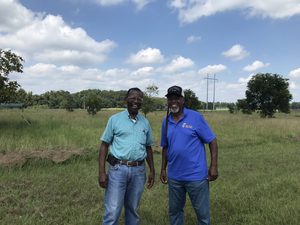
One of the highlights was a stop among ripening muscadine grapes. Educational value aside, there are few farm tours improved by unlimited access to fresh fruit. The muscadines were excellent.
The visit also provided an opportunity to reconnect with one of my favorite organic service providers, De'Anthony Price of the Rodale Institute. He traveled from the Atlanta area to join us, adding another perspective to the conversations taking place throughout the day.
Gatherings like this demonstrate one of the greatest strengths of agricultural education.
Knowledge rarely moves in only one direction.
Researchers learn from farmers.
Farmers learn from one another.
Service providers contribute expertise.
Students bring fresh ideas and energy.
The result is a community that grows stronger through collaboration.
The workshop participants gathered inside one of the greenhouse for a catered meal prepared with fresh ingredients. Good food has a way of encouraging good conversation, and by the time lunch ended I had met Millie Coleman.
The name immediately caught my attention because I was scheduled to visit her father, James Coleman, later that same day in Uvalda, Georgia.
"I want to help my dad with certification because I also want to get the greenhouse certified for my own crops," she explained.
Millie works as an extension agent at Fort Valley State University, just as Collie does. Her interest in certification reflects a broader theme I saw repeatedly throughout the Jubilee Justice network: families working together to create opportunities across generations.
The conversations during lunch were valuable, but they were not the only memorable meals associated with Fort Valley.
The previous day, we had all eaten at The Georgia Room, the university's longstanding cafeteria.
The experience was exactly what many people hope for when they imagine a Southern college dining hall. Sweet tea, roasted chicken, greens, macaroni and cheese, potatoes, and peach cobbler were all available in abundance.
The food was excellent.
Explaining the expense afterward proved more challenging.
Florida Organic Growers uses an automated travel reimbursement system, and the software became convinced that The Georgia Room was a cocktail lounge rather than a university cafeteria. It took several rounds of communication with accounting before everyone was satisfied that I had not submitted a $12 three-martini lunch to a federal grant.
The incident provided a welcome bit of comic relief during a week filled with long drives and full schedules.
As enjoyable as the workshops and meals were, my visit also highlighted an important issue related to organic certification. The university's organic farm appeared to have experienced a lapse in certification status in recent years.
My assumption is that the issue may have stemmed from administrative disruptions during the COVID-19 period, when many organizations struggled to maintain normal operations. Whatever the cause, it represents a challenge that will need attention if the university wants to expand its role in organic research and demonstration work.
This matters because Collie is developing rice demonstration projects associated with Fort Valley's educational programs. If organic certification becomes an important part of those activities, then restoring and maintaining certification for the farm will be necessary.
Fortunately, the situation appears solvable. The infrastructure is already in place. The expertise exists on campus. The commitment to farmer education is certainly present.
From my perspective, the opportunity is less about paperwork and more about potential.
Fort Valley State University has the people, facilities, and mission needed to become an important hub for organic grain education in the region. Rice could fit naturally into that work.
By helping farmers learn production methods, evaluate varieties, and understand certification requirements, the university could strengthen efforts already underway through Jubilee Justice and related organizations.
After thanking everyone at Fort Valley and saying my goodbyes, to everyone, including Collie Graddick, I headed east toward Uvalda, Georgia. If traffic cooperated and the daylight held, I would arrive in time to meet Mr. James Coleman at his farm before sunset.
Mr. James Coleman
Like many of the farmers involved with Jubilee Justice, Mr. Coleman is building something that extends beyond a single season's crop. His farm reflects both a working agricultural operation and a long-term investment in family, land, and opportunity.
During my visit, I learned as much about the family's plans as I did about the fields themselves.
Through conversations with both Mr. Coleman and his daughter, Millie Coleman, I came away with a clear understanding of their goals. Father and daughter intend to work together on an organic certification application that would include not only the three-acre Jubilee Justice rice system but also the high tunnel where Millie grows turmeric and other market crops.
That partnership stood out to me.
Throughout this journey, I repeatedly encountered families working together across generations. The Colemans provided another example of how knowledge, responsibility, and ambition are being shared within these farming communities.
As with any transition to organic production, however, opportunities come with challenges.
Mr. Coleman currently uses synthetic herbicides and other conventional weed-management tools elsewhere on the farm. Organic production requires a fundamentally different approach.
Without relying on chemical weed control, success will depend on careful planning, cultivation practices, crop rotation, and soil management.
That shift is not impossible, but it does require patience and adaptation.
Organic systems ask farmers to think proactively rather than reactively. Instead of treating problems once they appear, growers work to create conditions that reduce those problems from the beginning.
Weed pressure is likely to be one of the primary management challenges in the new organic acreage.
Irrigation presents another important consideration.
Reliable water management is critical for rice production, and the operation will need systems that can support both the rice fields and the high tunnel. Building infrastructure that is durable, efficient, and manageable will be an important part of the farm's development.
Disease management will also require attention.
During my visit, I observed some signs of rust within the rice planting. My impression was that the issue was likely related to environmental conditions rather than a major systemic problem. The field did not appear to be experiencing severe disease pressure, but it served as a reminder that rice production is rarely as simple as placing plants in the ground and waiting for harvest.
Healthy soil remains one of the most effective tools available to organic farmers.
Building soil through cover crops, organic matter additions, and thoughtful crop rotation helps create stronger plants that are naturally better equipped to tolerate stress from insects, diseases, and changing weather conditions.
For the Coleman farm, that foundation will be especially important. The more resilient the soil becomes, the easier it will be to manage crops without relying on synthetic inputs.
In many cases, producers struggle with certification because they view it as a paperwork exercise. The most successful applicants tend to see it differently. They view certification as a management framework that helps organize how a farm operates. The Colemans appeared to approach the process from that perspective.
Their operation is still evolving, and there are certainly details to work through. Yet the essential ingredients are already in place: land, commitment, family involvement, and a willingness to learn.
As daylight faded and I prepared to leave, I found myself thinking about a theme that had emerged repeatedly during my travels.
The story of Jubilee Justice is often told through rice. Rice is the crop that brings many of these farmers together, and it remains a powerful symbol of agricultural history and cultural heritage.
But the deeper story is about people. It is about families investing in the future. It is about farmers building systems that can outlast them.
Roy Mosely
My final farm visit brought me to one of the most impressive operations I saw during the entire trip.
Roy Mosely's farm is, in many ways, already operating according to the principles that organic agriculture is built upon. Long before certification enters the picture, the farm reflects a management style rooted in diversity, soil health, and long-term stewardship.
Roy's path into farming also speaks to a larger theme that surfaced repeatedly throughout this journey: keeping family land in agriculture.
Over time, he worked with his aunt to preserve this piece of family property. He began by leasing approximately ten acres from her and recently completed the purchase of the land himself. What started as a small opportunity has grown into a thriving operation that now includes both owned and rented acreage.
Unlike many farms that focus narrowly on a single crop, Roy has built a system that spreads risk and creates multiple sources of income.
Pork is the foundation of the business.
The pigs move through lush pastures filled with a mixture of crops and forage species, including corn, millet, cowpeas, and squash. Rather than viewing livestock and crop production as separate enterprises, Roy integrates them into a broader farming system.
The result is a farm that feels alive and interconnected.
At the home farm, roughly ten acres are actively managed. In addition, Roy rents another thirty-five acres nearby. Some fields are planted in cash crops while others are devoted to cover crops and soil-building practices.
That balance is intentional.
Healthy farms depend not only on what is harvested, but also on what is returned to the land.
Roy supplements his livestock enterprise with seasonal vegetable production. Depending on the time of year, he grows crops such as collards, broccoli, and watermelons. His produce has reached markets well beyond his local area, including customers in Chicago.
Notably, he has accomplished this without GAP certification.
Walking through the farm, I was struck by how naturally many organic principles were woven into the operation.
When people unfamiliar with agriculture hear the term "organic," they often think first about what farmers cannot use. They think about prohibited pesticides, herbicides, or fertilizers.
The more experienced organic farmers I know tend to think differently.
For them, organic farming is less about what is excluded and more about how a system functions.
Roy's farm embodies that approach.
Mixed plantings increase biodiversity. Cover crops protect and enrich the soil. Livestock contribute fertility and play a role in field management. Crop diversity reduces risk while creating multiple income streams.
Each piece supports the others.
As a result, the operation feels resilient in a way that many modern agricultural systems do not.
It is also one of the most mechanically equipped organic-style farms I encountered during my travels.
Throughout the property, I saw a wide range of implements designed for preparing fields, cultivating crops, and managing weeds without herbicides. The equipment reflected years of practical problem-solving and a commitment to producing food through management rather than chemical intervention.
Those tools matter.
One of the biggest challenges facing new organic growers is learning how to replace chemical weed control with mechanical and cultural practices. Roy has already invested in many of the systems needed to do that successfully at scale.
Within the context of Jubilee Justice, Roy currently manages three acres under the cooperative's System of Rice Intensification (SRI) model.
From a certification standpoint, the rice acreage presents an interesting opportunity.
Because the three-acre block is already a clearly defined production unit, it would likely be relatively straightforward to include it within a cooperative Organic System Plan. The boundaries are distinct, the management practices are identifiable, and the record-keeping requirements could remain focused on that specific portion of the operation.
That simplicity has value.
Organic certification can seem overwhelming when an entire farm enters the process at once. Starting with a smaller, well-defined production area allows farmers to gain experience with certification requirements before expanding further.
For Roy, that may be the most practical approach.
If he eventually decides to certify the livestock operation and the rest of the farm's crop production, a separate and more comprehensive Organic System Plan would likely make sense. Such a plan would need to address the full complexity of the operation, including livestock management, feed sourcing, pasture practices, crop rotations, and marketing channels.
That is certainly achievable, but it represents a larger undertaking.
My recommendation would be to begin with the three-acre Jubilee Justice system and keep the paperwork focused on that acreage.
Because Roy does not appear to rely on prohibited inputs elsewhere on the farm, certification requirements for the rice block should remain relatively manageable. The documentation burden would be limited, allowing him to become comfortable with record keeping and inspection procedures before considering broader certification.
Looking further ahead, I see even greater possibilities.
Within a few years, assuming time and capacity allow, I would encourage Roy to develop both a full Organic System Plan and a food-safety program that could support GAP certification.
Taken together, those steps would expand the range of markets available to the farm and allow more of its products to capture premium prices.
More importantly, they would help strengthen an operation that is already doing many things exceptionally well.
What impressed me most about Roy's farm was not any single crop, field, or enterprise.
It was the overall balance of the system.
So much of modern agriculture pushes farms toward specialization. Operations become larger and more efficient by focusing on fewer products.
Roy has followed a different path.
His farm relies on diversity rather than simplicity. Crops support livestock. Livestock support soil health. Cover crops support future harvests. Revenue comes from multiple sources rather than a single commodity.
That approach requires more management, but it also creates resilience.
As I left the farm, I found myself thinking that Roy's operation offers a glimpse of what many organic farmers aspire to build. It is productive, diversified, adaptable, and deeply connected to the land.
The rice field that links him to Jubilee Justice may occupy only three acres, but it is part of a much larger vision.
Like so many of the farmers I met along this journey, Roy is building something intended to last beyond the next season or the next harvest.
He is building a legacy.
And if Jubilee Justice succeeds in its broader mission, that legacy will be strengthened by a community of farmers doing the same work together.
Two more farmers I must mention
Allow me to take us back to that last night in Alexandria in September, when Jubilee Justice had everyone out for dinner at the home farm. As I walked up to the growing and milling crowd, there, across the patio sat Hilary Gobert, a farmer I had been trying to connect with for a few weeks.
But he was deep in conversation with someone else, maybe I needed someone to make an introduction for me?
Eventually, I got up the nerve, and approached Mr. Gobert and introduced myself, and told him I wanted to help him get certified organic.
He said, "Oh yes, I was hoping you would come and visit my farm," which left me feeling sheepish because if I had only had his phone number earlier, I could have done that earlier in the trip.
In any case, Mr. Gobert proceeded to describe his 65 acres with pastured cattle and poultry, plus his garden where he grows okra and mustard greens. I was immediately relieved because it turns out he's a retired professor and has a good handle on his business and his paperwork, and that kind of person is just going to be easy to get certified organic.
Mr. Gobert is already ecologically minded and opposed to the use of toxins in the food production system and has a deep understanding of what the organic system is all about.
Lucky for me, at Florida Organic Growers we have a lot of partners when it comes to organic transition work with farmers. Little did I know, but Kaia Shivers from Black Farmers Index was able to get out to visit with Mr. Gobert that weekend, and she had all the intel I needed on his farm.
Kaia has known Mr. Gobert for years and reported to me that she was shocked when Mr. Gobert told her that he was going to get certified organic, because in her long history with him, he had never been interested in going through the process.
Apparently, the prospect of being able to certify his rice fields as a part of the Jubilee Justice OSP was enough to turn him completely positive on the certification process.
Secretly, I know that Mr. Gobert will end up doing his own OSP, and getting Driftwood Farm certified in its own right, because honestly, it will not be that great a burden for his farm, as they have a limited number of products that they sell, and have no interest in using chemical fertilizers or pesticides.
Also, I think once Mr. Gobert sees how the certification program works on the 3 acres he uses to grow for the Jubilee Justice cooperative, he will want to get a premium at market on the poultry and beef and everything else that he produces on his farm that he is now distributing himself.
Another Jubilee Justice farmer that I met that night in Alexandria was Moses Momany, from Minnesota. I have honestly never heard of such a do-it-yourself organic agriculture success story as Moses can tell.
As a new farmer in the state of Minnesota and a recent immigrant from Africa, he was able to build a successful track record over several years of growing that convinced the USDA to loan him enough money to buy a large parcel of farmland, and he was certified organic long before Jubilee Justice existed.
Moses went on to convert his own farm into a communal farm to shepherd other new growers, and in the process decided that the disparate practices among the farmers on the land made it too hard to keep the records required to maintain certification.
However, now Moses is ready to make another OSP for the organic rice he would like to grow and sell through the Jubilee Justice Cooperative. Moses is still doing trials on which rice varieties will work best for him and other Minnesota farmers, but I think we can add him to the list of Jubilee Justice farmers who will be certified organic in the not-too-distant future.
In Conclusion
As I drove away from Roy's farm, that day in August, I found myself reflecting on everything I had seen across Georgia and Alabama, and what hadn't yet seen: the mill that Jubilee Justice built in Louisiana. On the surface, this story is about rice. It is about heirloom seed, organic certification, milling infrastructure, and farmers learning to grow a crop that connects them to a history stretching back centuries.
But rice is really just the thread that ties the larger story together.
What I encountered throughout these travels was a community of people reclaiming ownership of their future. Some are restoring family land that has survived generations. Some are creating opportunities for their children and grandchildren. Others are building the infrastructure, knowledge, and relationships needed to ensure that farmers capture more of the value of what they produce.
The fields are important. The mill is important. Organic certification is important. Yet none of these things are the real heart of Jubilee Justice.
The heart of Jubilee Justice is a belief that communities can be rebuilt through cooperation, stewardship, and shared purpose.
Everywhere I went, I met people investing not simply in a crop, but in one another. They were sharing equipment, knowledge, risk, and opportunity. They embody the truth that farming is not just about food production. It can also be about restoring connections between people, land, culture, and history.
African rice survived centuries because generations of people preserved it. Today, the farmers of Jubilee Justice are preserving something larger. They are preserving agricultural knowledge, family legacies, and pathways to land ownership and economic independence for those who come after them.
Whether the cooperative ultimately grows thousands of acres or only a few hundred, that may not be its most important accomplishment. Its greatest success may be the community it has built and the example it offers: that when farmers work together, they can do more than grow food. They can create the conditions for future generations to thrive.
And that, more than the rice itself, is what makes my on-going journey with Jubilee Justice worth taking.

Sebastian Interlandi- SE TOPP Technical Assistance Specialist - Florida Organic Growers


